
24/7 legal intake helps law firms capture more leads, improve response times, reduce missed calls, and qualify prospects before they ever reach an attorney. Firms that use a dedicated legal answering service often find it easier to convert inquiries into consultations, reduce overhead compared to in-house coverage, and give attorneys more time to focus on billable work.
This page covers the core benefits of 24/7 legal intake, including how it affects client conversion rates, what outsourcing law firm phone calls looks like in practice, how lead qualification works, and what the ROI typically looks like for firms of different sizes.
Want to see how 24/7 legal intake could work at your firm? Contact Veza Reception to learn more.
Benefits of 24/7 Legal Intake for Law Firms
Legal emergencies do not follow business hours. A person injured in a car accident on a Friday evening is not likely to wait until Monday to call an attorney. They are more likely to contact several firms and move forward with the one that responds first. For law firms, speed to first response often determines whether an inquiry becomes a consultation or goes to a competitor.
Response speed is one of the clearest drivers of legal intake performance. Clients expect quick follow-up, yet many law firms still fall short when it comes to responsiveness.
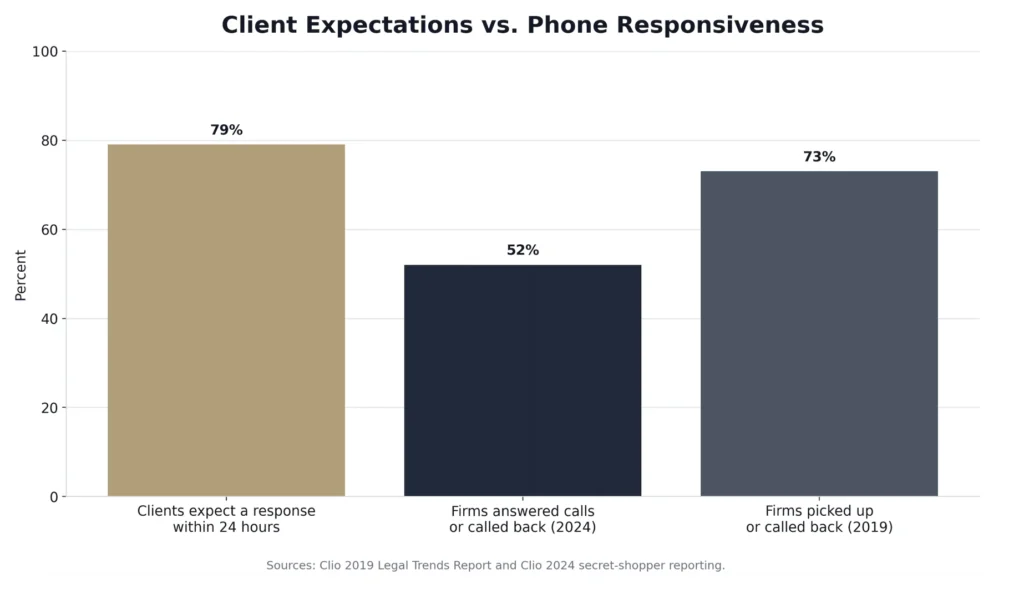
Source: Clio client intake research, https://www.clio.com/blog/client-intake-process-stages
This gap helps explain why 24/7 legal intake can create an immediate competitive advantage. When your firm responds quickly instead of sending callers to voicemail or delayed follow-up, it has a better chance of turning inquiries into consultations.
A 24/7 legal intake service ensures your firm is reachable at all hours, including evenings, weekends, and holidays. This is particularly valuable in practice areas where urgency drives decisions, such as personal injury, criminal defense, family law, DUI, and immigration.
Key benefits of 24/7 availability include:
- Capturing leads that would otherwise go unanswered after hours
- Responding to prospective clients before competing firms do
- Projecting professionalism and responsiveness from the very first contact
- Reducing pressure on in-house staff during business hours
In practice, after-hours coverage alone is often where firms see immediate value. Evenings and weekends can account for a meaningful share of new client calls, and having trained agents available during those windows means fewer opportunities are lost to simple availability gaps.
How Does a Legal Answering Service Improve Client Conversion Rates?
Answering the phone is only the start of the conversion process. How the call is handled in the first few minutes has a direct effect on whether a prospect books a consultation and whether they ultimately move forward with your firm.
Legal answering service agents are trained specifically for law firm intake. They know how to handle distressed or anxious callers with empathy, gather essential case details efficiently, communicate your firm’s process clearly, and guide prospects toward the next step. This creates a very different experience from reaching a distracted receptionist, a generic call center, or voicemail.
For most firms, the conversion lift comes from consistency more than anything else. When every caller receives the same professional, intake-focused experience regardless of when they call, fewer leads fall through the cracks. In practice areas like personal injury, where a single retained case can generate substantial contingency fees, even a modest increase in consultation bookings can have a measurable revenue impact.
Factors that drive conversion improvement include:
- Trained agents who understand legal intake rather than general customer service
- Immediate response with no hold times or voicemail loops
- Empathetic handling of emotionally distressed callers
- Clear consultation scheduling and confirmation
- A consistent brand experience regardless of time of day
Benefits of Outsourcing Law Firm Phone Calls
Outsourcing law firm phone calls reduces overhead, improves coverage consistency, and frees your internal team to focus on work that actually requires their expertise. For many firms, it turns a variable and often unreliable function into a predictable, managed service.
The in-house coverage problem
In-house reception often has gaps that are easy to overlook. Lunch breaks, PTO, sick days, and staff turnover all create windows where calls go unanswered or get handled by attorneys and paralegals who are pulled away from billable work. When a paralegal stops reviewing a case file to take a new client inquiry, the firm is paying a high per-minute rate for work that does not need that level of expertise.
Intake quality can also vary when responsibility is spread across multiple employees. A dedicated legal answering service uses consistent scripts, trained agents, and quality assurance processes, so the experience a caller gets on a Tuesday morning is the same as what they get on a Saturday night.
Many firms do not lose leads because of legal skill. They lose them because their intake process is hard to reach, slow to respond, or inconsistent across channels.
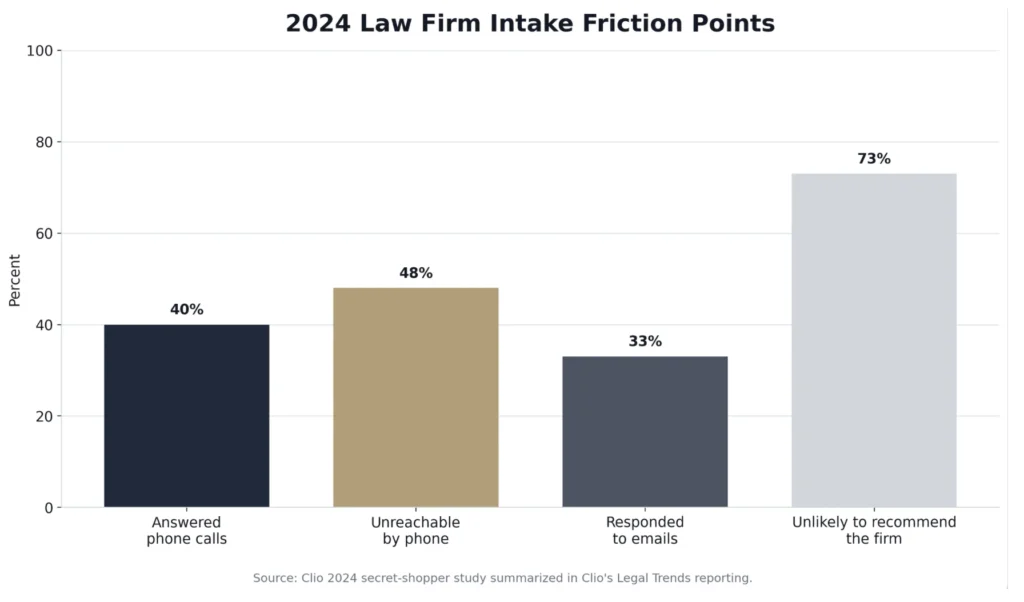
Source: Clio 2024 client engagement research https://www.clio.com/guides/client-intake-legal-trends/
These intake gaps help explain why outsourcing can improve both coverage and consistency. When calls are answered reliably and follow-up is handled in a more structured way, fewer potential clients fall through the cracks.
What outsourcing typically delivers:
- Predictable monthly cost instead of variable in-house staffing overhead
- No single point of failure when a receptionist is out
- Scalable capacity during high-volume periods without additional hiring
- Call logs, intake summaries, and pipeline reporting built in
- Better consistency in how new inquiries are handled
- Support for confidentiality and intake processes appropriate for law firms
How Legal Answering Services Handle Lead Qualification
One of the most practical and often underestimated benefits of a legal answering service is lead qualification, the process of screening calls before they reach an attorney’s desk. Not every inquiry is a viable case, and attorney time spent on unqualified consultations is a direct overhead cost.
A well-configured legal intake service works from a custom script built around your firm’s specific criteria. Agents gather the information your attorneys need to evaluate fit, then route calls accordingly without interrupting anyone at your firm. This is especially valuable for firms that already have defined intake criteria, conflict-check steps, and consultation booking rules.
In practice, that means each new inquiry can be screened through a structured process before attorney time is used.
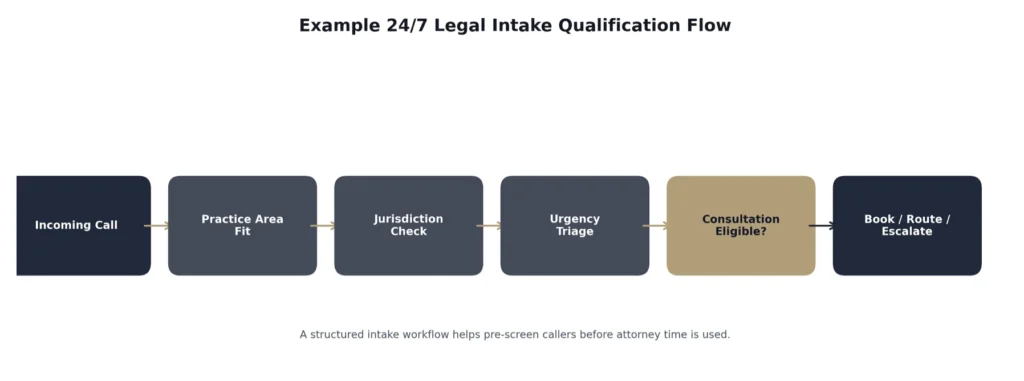
This kind of workflow helps firms spend less time on poor-fit calls and more time on consultations that are actually worth pursuing.
Common qualification criteria by practice area
Personal injury: liability, injury severity, treatment status, and statute of limitations
Family law: jurisdiction, asset profile, whether children are involved, and urgency level
Criminal defense: charge type, jurisdiction, court date, and prior representation
Immigration: visa status, country of origin, filing deadlines, and case history
Business law: entity type, dispute value, contract existence, and timeline
What qualification screening typically covers
- Practice-area fit: Does this case type match what your firm handles?
- Conflict screening: Are there any obvious issues before deeper engagement?
- Jurisdiction: Is the caller in your service area?
- Urgency triage: Does this matter need same-day attention or standard scheduling?
- Consultation eligibility: Should this caller be booked, routed, or handled another way?
The result is that by the time a prospect reaches an attorney, they have already been pre-screened. Consultations become shorter, more productive, and more likely to result in a signed retainer because the obvious mismatches have already been filtered out.
What Is the ROI of a Legal Answering Service for Law Firms?
The ROI of a legal answering service is best understood across several areas: leads captured, consultations booked, attorney time recovered, and overhead reduced. For many firms, the math is straightforward.
Where the return comes from:
- Fewer missed leads: After-hours and overflow calls that previously went to voicemail now get answered and logged
- More consultations booked: Trained intake agents can convert a higher percentage of inquiries into scheduled appointments
- Less staff interruption: Attorneys and paralegals spend less time handling intake calls and more time on billable work
- Lower overhead than in-house coverage: A monthly service fee is often far less than the cost of a full-time receptionist’s salary and benefits
- Better attorney time allocation: Pre-qualified leads make consultations more efficient and more likely to convert
A useful benchmark is that the monthly cost of a legal answering service may be covered by one or two additional retained cases. In contingency fee practices like personal injury, a single case that would otherwise have gone unanswered can generate fees that outweigh many months of service costs. In hourly practices, recovering even a few hours of attorney time from intake interruptions can justify the investment.
For smaller firms especially, the ROI case is often strong. A solo practitioner or small team that cannot justify full-time reception coverage can still get professional, consistent intake without the fixed overhead of an in-house hire and compete more effectively with larger firms on responsiveness.
Frequently Asked Questions
Is 24/7 legal intake worth it for small law firms?
Yes. In many cases, small firms benefit more than large ones because solo practitioners and small teams often have no dedicated receptionist. That means new client calls may go unanswered during court appearances, client meetings, or after hours. A 24/7 intake service provides professional coverage at a predictable cost without requiring a full-time hire.
Does outsourcing law firm phone calls improve conversion rates?
For most firms, yes. The improvement usually comes from two things: availability and intake quality. First, more calls get answered instead of going to voicemail. Second, those calls are handled by trained agents focused on moving inquiries toward consultations rather than simply taking messages.
Can a legal answering service qualify leads for a law firm?
Yes, and this is one of the most valuable functions it can provide. A legal answering service can follow a custom intake script that screens callers based on your firm’s criteria, including practice area, jurisdiction, case type, urgency, and consultation eligibility. Qualified prospects can then be routed appropriately without using attorney time on poor-fit calls.
What types of law firms benefit most from 24/7 intake?
Practice areas where urgency and emotional stakes are high often see the strongest results. Personal injury, criminal defense, family law, DUI, and immigration all generate meaningful after-hours call volume. That said, any firm losing leads to missed calls or inconsistent intake handling can benefit from stronger coverage.
How much does a legal answering service cost compared to in-house coverage?
Pricing varies by provider and call volume, but legal answering services usually cost much less per month than a full-time receptionist when salary, benefits, and paid time off are included. Many firms find the service pays for itself when even one additional case per month is retained because intake coverage improved.
How Veza Reception Handles 24/7 Legal Intake
At Veza Reception, 24/7 legal intake is built around each law firm’s intake process rather than a generic call center script. Calls are answered in your firm’s name, handled by trained legal receptionists, and routed based on the criteria that matter to your practice.
That can include customized intake questions, practice-area screening, urgency-based routing, consultation booking rules, and escalation instructions for high-priority calls. Instead of sending every caller through the same generic workflow, Veza Reception helps law firms create a more consistent intake process that reflects how their team actually operates.
For firms that want more than simple message taking, that matters. A legal answering service should not just pick up the phone. It should help screen leads, protect attorney time, and support a better client experience from the first conversation.
The Bottom Line
24/7 legal intake is not just an extra feature for firms with a larger budget. It is a practical part of how competitive law firms capture and convert leads in a market where response time matters. The combination of round-the-clock availability, trained intake agents, structured lead qualification, and predictable overhead can lead to more consultations booked, better use of attorney time, and a stronger return on marketing spend.
For many law firms, the real cost is not the service fee. It is the value of the qualified leads and retained cases lost when calls go unanswered.
A legal answering service should do more than answer calls. It should help your firm capture more qualified leads, book more consultations, and protect attorney time.