
Choosing a legal intake service provider is not just about getting calls answered. The right provider should help your firm capture leads quickly, qualify them accurately, integrate with your existing systems, and protect client information from the very first interaction.
The best legal intake service providers do more than answer calls. They qualify leads, follow your scripts, integrate with your systems, and help your firm respond faster without sacrificing accuracy. If you are also comparing broader front-office coverage options, see our guide to the best legal answering service providers.
Here are the most important things to look for before you sign with any legal intake company.
Who This Guide Is For
This guide is for solo attorneys, small law firms, and growing practices that want to improve lead capture, response times, and intake quality without relying on a generic answering service. If you are a solo attorney still comparing providers, you may also find our guide to the top 7 answering services for solo practitioners helpful.
If you are evaluating providers for the first time or replacing a service that is not performing well, the criteria below are designed to give you a practical framework for comparison.
Quick Checklist: What to Look for in a Legal Intake Service Provider
- Legal-specific training
- 24/7 live coverage
- Custom intake scripts
- CRM and case management integrations
- Fast response times
- Conflict-checking workflow
- Transparent pricing
- QA and call reviews
- Multichannel intake
- Law firm references
At a Glance: What to Look For, Why It Matters, and What to Ask
| What to Look For | Why It Matters | What to Ask |
|---|---|---|
| Legal-specific training | Better lead qualification and client experience | How are agents trained for legal calls? |
| 24/7 live coverage | Captures leads that arrive outside business hours | Who handles after-hours calls, and how are they trained? |
| CRM integration | Less manual work and fewer data errors | Which systems do you integrate with directly? |
| Custom scripts | Intake that fits your practice areas | How quickly can scripts be updated? |
| Response speed | Keeps leads engaged before they search elsewhere | What is your average response time for calls and web leads? |
| Conflict protocol | Reduces intake risk | How are potential conflicts flagged and handled? |
| QA and call reviews | Consistent service quality over time | Can I see sample call scorecards or QA reports? |
| Transparent pricing | Predictable monthly costs | Can I see a sample invoice at my expected call volume? |
1. Legal-Specific Training
General answering services handle everything from HVAC companies to e-commerce stores. Legal intake is different — and it requires staff who understand that difference.
Look for providers whose teams are trained specifically in legal terminology, client sensitivity, and the ethical boundaries attorneys must operate within. Intake specialists should know not to offer legal advice, understand the urgency of different case types (personal injury, criminal defense, immigration), and be comfortable asking the qualifying questions your firm actually needs.
Ask potential providers directly: How do you train your staff for legal intake specifically? A vague answer is a red flag.
2. 24/7 Live Coverage for Law Firm Intake
Legal situations do not follow business hours. A potential client needs to reach a live person when it matters — including evenings, weekends, and holidays.
Confirm that after-hours coverage is handled by trained live agents, not voicemail or a basic automated system. Some providers offer 24/7 service in name but route after-hours calls to a general overflow team with no legal training. Ask who specifically handles calls outside business hours and how those agents are trained.
3. Multichannel Intake Capabilities
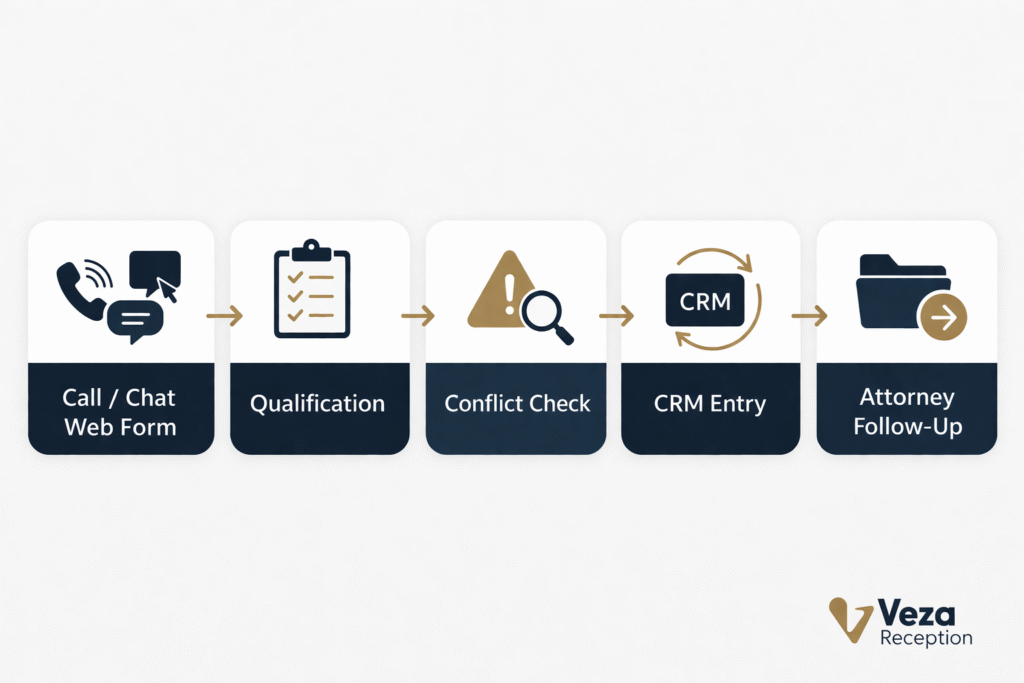
Modern clients reach out through multiple channels — phone calls, web forms, live chat, and text messages. Your intake provider should be able to capture and manage leads across every channel you use, routing them consistently through your qualification process regardless of how a prospect first makes contact.
Look for providers that support:
- Live phone answering
- Web chat and chatbot integrations
- SMS and text follow-up
- Online intake form processing
- Missed-call callbacks and outbound follow-up on web leads
The more channels they cover, the fewer leads fall through the cracks.
4. Custom Scripts and Qualification Criteria
No two law firms are identical. A personal injury firm qualifying slip-and-fall cases needs very different intake questions than an immigration attorney screening visa applicants. Your provider should build intake scripts around your firm — not force you into a one-size-fits-all template.
Before signing any contract, ask:
- Can we review and approve the scripts used for our firm?
- Can we update qualification criteria as our practice areas evolve?
- How quickly can script changes be implemented?
Flexibility here is non-negotiable. Rigid scripts produce misqualified leads and wasted consultation time.
5. CRM and Case Management Integrations
Your intake service should work with your existing systems, not around them. The best providers integrate directly with platforms like Clio, Lawmatics, MyCase, and Filevine — automatically logging call notes, creating new contact records, and triggering follow-up tasks without requiring manual data entry from your staff.
This matters beyond convenience. It eliminates transcription errors, speeds up follow-through, and gives you a clean audit trail from first contact to retained client. Ask which systems the provider integrates with natively versus through a workaround, and what data is synced automatically.
6. Speed to Response
In legal intake, response time often has a major impact on whether a lead stays engaged with your firm or continues searching elsewhere. When a potential client submits a form or calls and gets no answer, they move on — frequently to the next firm in search results.
A strong provider should be able to share concrete data on their average response times, including for web form submissions, missed-call callbacks, and chat conversations. Ask for actual numbers, not general assurances.
7. Conflict-Checking Process
Law firms have to be careful about conflicts of interest during intake. A strong legal intake provider should know when to pause, flag, or limit an intake if a potential conflict may exist. They should also know how to avoid collecting unnecessary sensitive information before the firm has cleared the matter and decided how to proceed. Ask whether the provider has a documented workflow for conflict screening and confidentiality.
8. Transparent Pricing
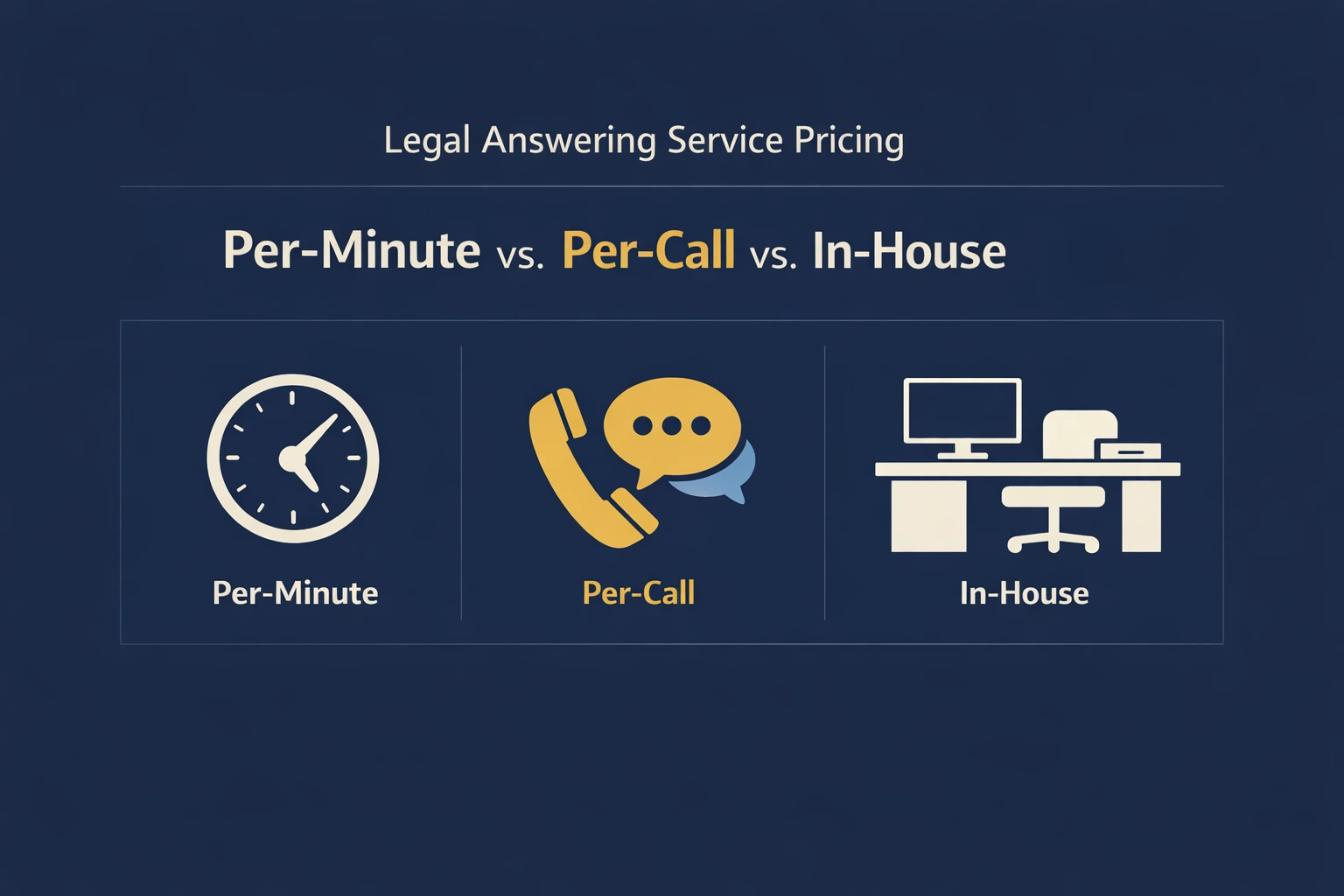
Intake service pricing models vary widely — per-minute, per-call, per-lead, flat monthly rates, or some combination. Ask whether pricing is billed per minute, per call, per lead, or at a flat monthly rate, then compare those models against your average call length and intake complexity. A flat-rate plan may look appealing but become expensive if your calls tend to run long.
Watch out for:
- Billing increments that round up aggressively (e.g., billing 5-minute minimums for shorter calls)
- Undisclosed fees for after-hours or overflow calls
- Overage rates that were not clearly disclosed upfront
Ask for a full rate card and a sample invoice based on a realistic call volume before committing. You can also compare common billing models and cost structures in our legal answering service pricing guide.
9. QA and Call Monitoring
How does the provider ensure their agents are performing consistently? Look for companies that offer call recording, regular QA reviews, scorecards, calibration sessions, and a clear coaching process when issues arise. The best providers will proactively share call recordings for your review and maintain a feedback loop that actually influences how agents handle your calls over time.
Also ask about staff turnover. High turnover in an intake center often translates directly to inconsistent service as new agents are brought up to speed on your firm’s requirements.
10. Experience Handling Intake for Law Firms
Ask for references from law firms — ideally in your practice area. Case studies, client examples, and direct references carry far more weight than general marketing claims. A provider that has served criminal defense firms for several years understands the urgency and sensitivity of that intake context in ways that newer or more generalist entrants simply will not.
Questions to Ask Before Hiring a Legal Intake Provider
Use these when evaluating any provider:
- How do you train agents specifically for legal intake?
- Which CRMs and case management tools do you integrate with directly?
- How are script changes handled, and how quickly can updates be made?
- Do you support text, chat, web forms, and after-hours intake?
- How do you handle potential conflict situations?
- Can you share sample QA reports or call review scorecards?
- What does your billing actually look like on a real invoice at my expected call volume?
- Can you provide references from law firms similar to ours?
Red Flags to Watch For
Walk away — or ask much harder follow-up questions — if you encounter any of these:
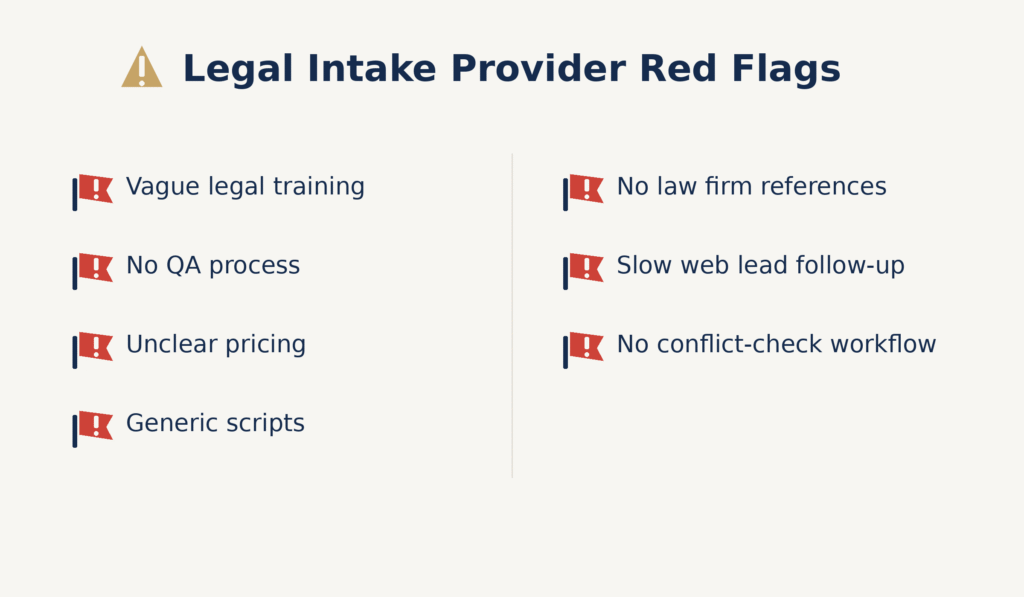
- Vague or evasive answers about legal training
- No call recordings or formal QA process
- Unclear overage pricing or billing increments
- Generic, non-customizable scripts
- No law firm references
- Slow or no follow-up on web form leads
- No documented conflict-check process
How to Apply This Checklist to Any Provider
The criteria in this guide apply to any intake company you evaluate. As one example, when looking at a provider like Veza Reception, which provides law firms with legal receptionist services, you would want to see how the team is trained, how intake scripts are tailored to your practice areas, what systems are supported, and whether quality control and after-hours coverage are part of the service. Those details matter because a good intake partner should feel like a seamless extension of your firm, not just a company answering the phone.
If you’d like to learn more, explore our services, review our pricing, or request a sample call flow.
The Bottom Line
The right legal intake service provider should function as a dependable extension of your firm. When evaluating options, prioritize legal expertise, availability, integration capabilities, and transparent pricing — then verify each with direct questions and actual references.
Frequently Asked Questions
What does a legal intake service provider do? A legal intake service provider answers calls, chats, and web inquiries on behalf of a law firm, gathers qualifying information from prospective clients, screens cases against your criteria, and routes warm leads to your team. Most providers also integrate with legal CRMs to log intake data automatically.
How is a legal intake service different from a general answering service? A general answering service is trained to take messages and transfer calls. A legal intake service is trained specifically for law firms — its agents understand legal terminology, know not to offer legal advice, follow case-specific qualifying scripts, and in many cases can flag potential conflict situations before a full intake is completed.
Do legal intake providers integrate with Clio or Lawmatics? Many do, but the depth of integration varies. Some providers sync contact records and call notes automatically; others require manual exports or third-party middleware. Always ask which platforms are natively supported and what data is transferred in each direction before committing.
How much does a legal intake service cost? Pricing varies based on call volume, service model, coverage hours, and whether the provider charges per minute, per call, per lead, or at a flat monthly rate. Smaller firms with lower call volume may prefer per-minute or per-call plans, while higher-volume firms may prefer flat-rate pricing for predictability.
What questions should I ask before hiring a legal intake provider? The most important questions are: How are your agents trained for legal calls? How quickly can scripts be updated? How do you handle potential conflict situations? Can you share sample QA reports? Which CRMs do you integrate with directly? And what does a real invoice look like at my expected call volume?
Can a legal intake service handle after-hours and weekend calls? Yes — and this is one of the primary reasons law firms use them. Confirm that after-hours calls are handled by trained live agents, not transferred to a voicemail system or a generalist overflow team. Ask specifically who answers your calls at 10 p.m. on a Saturday and how they are trained.